I led design across five companies at once, Four kept investing in design afterwards.
The programme: The Design Age Institute at the Royal College of Art (RCA) brought together five external companies to build products and services for an ageing population. Each company had a different product, business model, team structure and level of design maturity, but all were facing a similar challenge: they needed stronger design leadership to turn ambitious ideas into meaningful products.
My role: Design Manager & Consultant. I led design across all five companies at the same time.
The goal: Leave each team better at making design decisions than when I arrived.
Impact
• 4 of 5 organisations kept investing in design after the programme
• 12+ user research sessions and workshops across all five companies
• 10+ companies and partners trained in human-centred design
• 65% improvement in usability, measured through RCA evaluations
• 75% improvement in design quality across the five projects within six months
(final programme report)
* Much of this work is covered by confidentiality agreements, so this page focuses on my role, approach and impact rather than product details.



Each project was evaluated and validated through the same underlying methodology:
→Understanding people's needs
→ prototyping
→ testing
→ learning
→ iterating
→ and deciding / repeating.
....Until the final deadline.


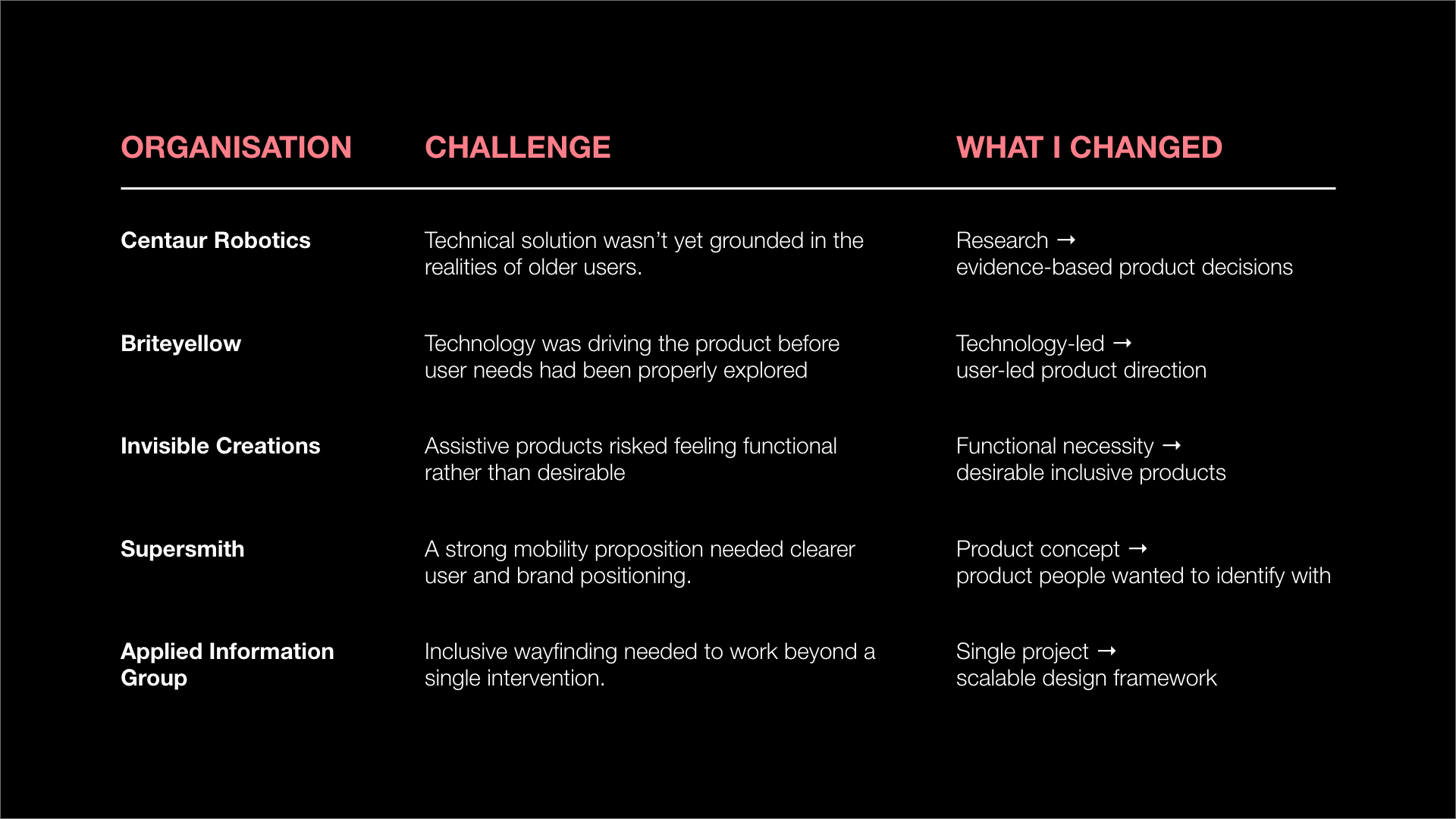
Centaur Robotics: designing for the realities of older users
What they were building: A self-balancing electric vehicle (EV) for older adults.
The issue: The controls needed to work for people with arthritis and limited dexterity.
What I did: Led two full-day workshops with 20+ older adults. Engineers and the product team took part. We tested button types, icons and placement on physical prototypes.
Outcome: User evidence turned into concrete decisions about how people could control the vehicle safely and confidently.
My role: Research leadership · Cross-functional facilitation · Product decisions


Briteyellow: changing what the team thought it needed to solve
What they were building: An extended reality (XR) train journey planner and navigation experience for older adults.
The issue: Strong technical skills, but little UX or research capability, and a focus on delivering a solution before understanding the problem.
What I did: Reshaped the design brief and moved the team towards exploration, research and iteration. I helped them identify the UX and research skills they needed.
Outcome: The work contributed to 6 commercial bids with Transport for Wales, and the proposition moved towards UK-wide deployment.
My role: Product direction · Leadership coaching · Stakeholder alignment


Invisible Creations: making inclusive products desirable, not just functional
What they were building: Mobility products that help older people stay independent without the stigma of "assistive" products.
The issue: A capability gap in design.
What I did: Sourced external design support and led research with 12+ older adults using physical prototypes, VR, surveys and interviews. We looked at how people move around homes and gardens, not just at the grab rail itself.
Outcome: Assistive features became part of attractive everyday objects, such as garden products, window boxes and outdoor lighting. The range is now sold through B&Q.
My role: Capability building · External design direction · Product strategy


Supersmith: turning user insight into a product people want to live with
What they were building: A three-wheeled mobility scooter that seats riders at 90% of standing height, to avoid the awkward social dynamics of sitting low.
The issue: Making the design communicate modernity, durability and safety.
What I did: Coached the team rather than taking over the design. I helped them link user insight to product decisions and challenged how the look of the product expressed its values.
Outcome: The team understood how product design, user perception and brand positioning work together.
My role: Design coaching · Product positioning · Design direction


Applied Information Group: turning inclusive research into something that scales
What they were building: A national walking and cycling wayfinding system for an ageing, increasingly diverse population.
What I did: Guided the team in creating an Inclusive Wayfinding Toolkit, bringing together research and design principles on mobility, socialising, access to services, safety and confidence.
Outcome: A framework that can shape wayfinding across different places and organisations, and feeds into wider discussions on ageing and inclusive design.
My role: Design strategy · Inclusive design · Framework development
Set direction and kept a steady rhythm
I agreed goals and milestones with each team at kick-off, then held weekly check-ins with all five. These surfaced problems early, kept scope under control, and kept user needs visible when technical or commercial pressure grew.

Taught teams to use testing to make decisions
Many teams had never run structured research. I helped them decide what they needed to learn, find their riskiest assumptions, and design sessions around real user behaviour. In sessions I coached them to avoid leading questions. Afterwards I helped them separate observations from assumptions.
This moved teams from "users said they liked it" to "this evidence tells us to change X."
The method fitted the product: workshops with physical controls for the EV, and prototypes, VR, surveys and interviews for the grab rail.

Contextual understanding

VR & physical prototypes' testing

Product feedback & comparison surveys


Made risk visible early
Risk came from many places: user needs, technology, funding, commercial viability, skills and stakeholders. I helped teams spot risks early, challenge assumptions, bring in specialists, and think through route-to-market, funding and agency choices.
The goal wasn't to remove risk. It was to make uncertainty visible early enough to act on.
A few months in, I ran a human centered design training session for more than ten companies and programme partners. It gave them practical tools, templates and frameworks.
The bigger aim was cultural. Many teams saw design as the last step of delivery. I wanted them to see it as a way to choose better opportunities earlier.
"Design isn't just how you make something. It's how you decide what is worth making."
The programme's processes, templates and frameworks became part of the RCA's reusable toolkit for future programmes.
You can read a summary of this talk here.

Snapshot of me providing training

Design Maturity Level Framework explained across all companies
The numbers (see the top of the page) mattered, but the clearest sign of progress was the questions teams started asking.
Before: "What should we build?"
After:
• "Who are we building this for?"
• "What evidence do we have?"
• "What problem are we actually solving?"
Sometimes that's setting direction. Sometimes it's coaching, or building skills, or stepping in directly.
The best moments weren't when I produced the best design. They were when a founder, engineer or product lead made a better decision because of our work together.
That's the kind of design leadership I want to practise: creating the clarity, capability and confidence for organisations to move forward.


